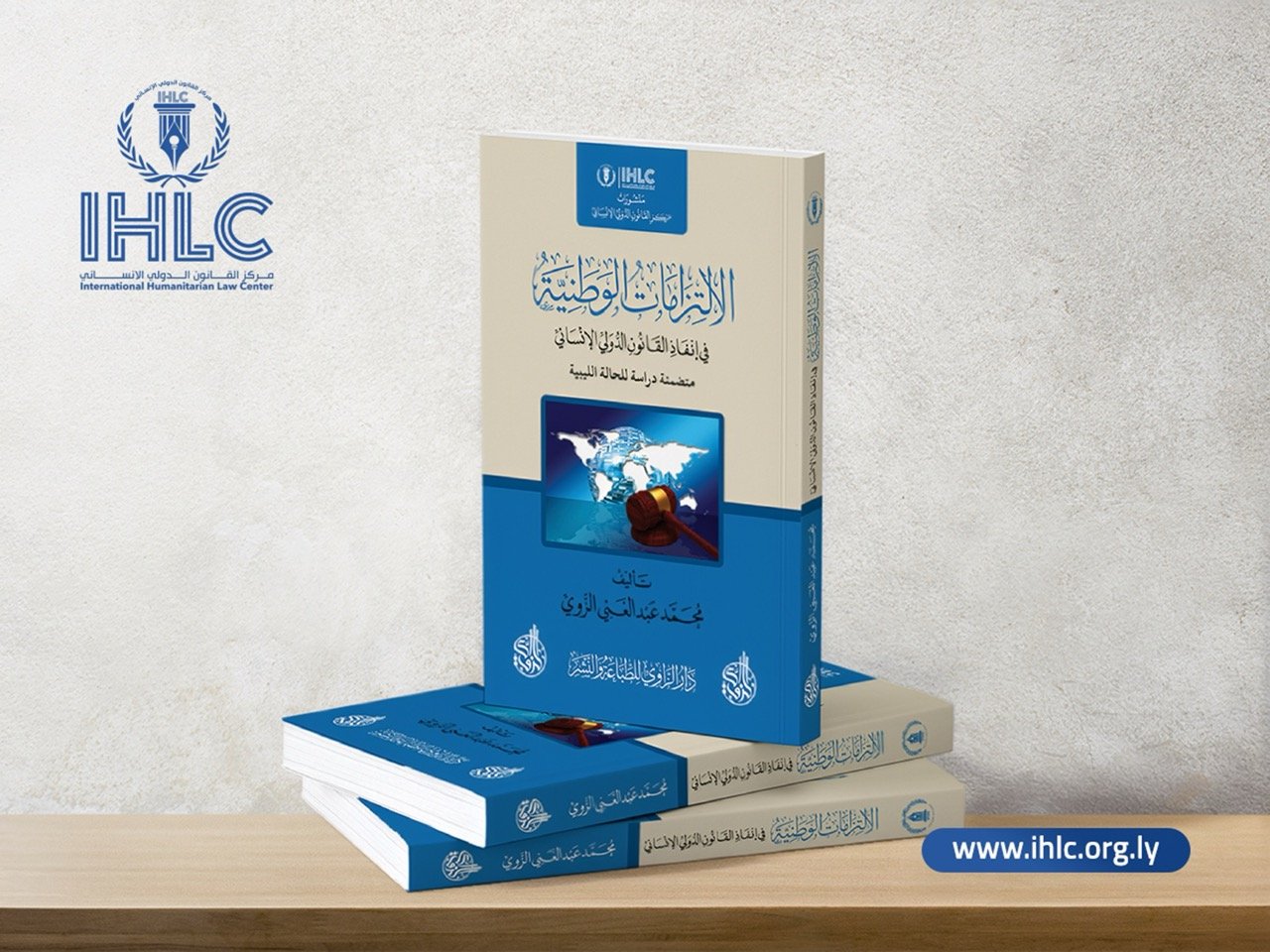
Book Title: National Obligations in the Implementation of International Humanitarian Law – An Analytical Study with Application to the Libyan Context
Author: Mohamed Abdelghani Raheel Al-Zwai
We are pleased to announce the publication of this scholarly book, which addresses one of the most significant legal issues at both the national and international levels: the extent to which states fulfill their obligations to implement the rules of International Humanitarian Law (IHL) domestically. The book offers an in-depth examination of the Libyan context and the developments this field has witnessed in recent years.
Study Summary
This research aims to identify and analyze the obligations placed upon states to enforce IHL at the national level, including legislative, preventive, and institutional measures. The importance of this topic lies in the fact that fulfilling these obligations ensures respect for and implementation of IHL rules, while failure to comply may trigger the state’s international responsibility.
The study thoroughly examines the Libyan situation by reviewing relevant national legislation and assessing the position of the Libyan judiciary—especially the Supreme Court—regarding international conventions to which Libya is a party, particularly those related to IHL.
The book is divided into two main chapters:
Chapter One: States’ efforts to implement IHL through legislative and preventive measures, with a detailed study of the Libyan case.
Chapter Two: National and international institutional mechanisms and their role in implementation, including the International Committee of the Red Cross (ICRC), the United Nations, and Libyan governmental and non-governmental bodies.
The study concludes with a set of key findings and recommendations aimed at strengthening national compliance with this vital branch of international law.
Key Findings:
National obligations for IHL implementation revolve around legislative and preventive measures, particularly incorporating international rules into domestic law and criminalizing violations.
The national judiciary plays a central role in implementing IHL, necessitating capacity-building and specialized training for judges.
Although Libyan legislation includes important provisions supporting IHL implementation, several areas still require development.
Supreme Court rulings demonstrate advanced legal awareness of international obligations, especially regarding the effects of armed conflicts and treaty applicability.
Libya has recently witnessed notable progress in establishing committees and organizations concerned with IHL, alongside enhanced academic and practical training efforts.
Key Recommendations:
Accession to international conventions that Libya has not yet joined.
Establishing a parliamentary committee to review IHL-related legislation and align it with international standards.
Creating a specialized court or judicial division for IHL violations.
Clearly defining the legal status of international treaties within the Libyan legal system.
Amending the Official Gazette Law to ensure the proper entry into force of treaties without undue restrictions.
Strengthening the independence of the National Committee for International Humanitarian Law.
Expanding training programs for judicial personnel and practitioners in related fields.
Organizing more conferences and seminars to address the challenges highlighted by the study.
Conclusion
This book represents a valuable scholarly contribution to the field of International Humanitarian Law. It provides researchers and practitioners with a precise analytical reference on national obligations and their implementation in Libya, while offering insightful perspectives for reform and further development in this crucial sector.